An add-on is an intervention, not a quality badge
The optional-services screen can create a familiar buying reflex: if one layer of protection sounds sensible, five layers must be safer. That logic produces parcels carrying redundant materials, avoidable volume and services that never addressed a real weakness. A better starting point is clinical. Name the failure you are trying to prevent, identify the object exposed to it, then select the smallest intervention that changes the outcome.
Sugargoo’s official service guidance separates add-ons applied to individual products from those applied during parcel consolidation. Its published examples include photography, shape support, fragile-item reinforcement and extended storage at product level, plus protective packing, volume reduction, parcel photography and insurance-related options at package level. That menu is a toolbox, not a universal prescription. Availability can depend on the item, parcel, destination and shipping method, so the current choices shown for an actual order should remain the operational source of truth.
Separate evidence, item handling and parcel handling
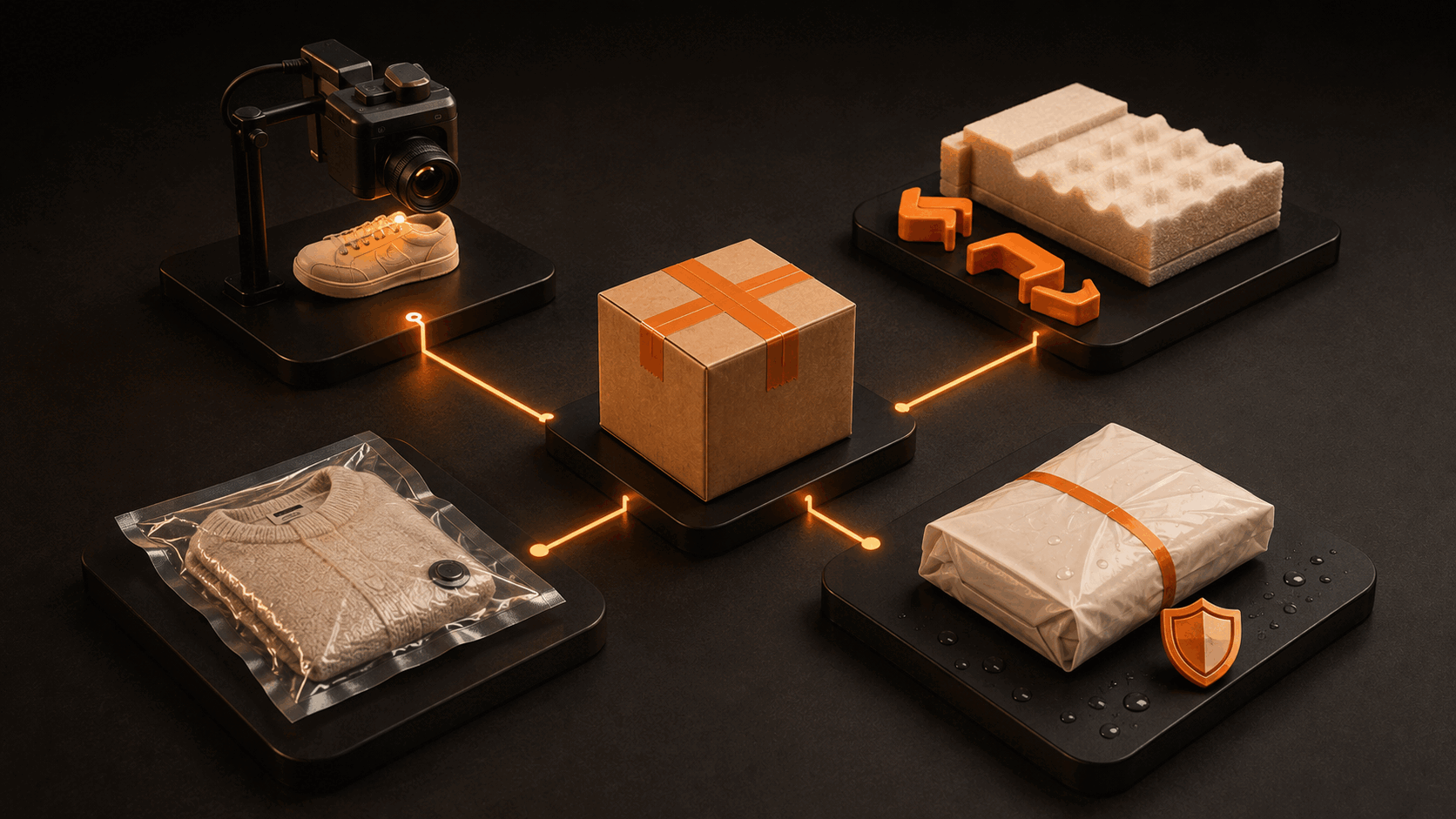
Every service request should belong to one of three layers. Evidence services answer a question before release: a requested product view, a close-up or a photograph of the completed package. Item-handling services protect or reshape one object: a shoe tree, hat support, removal of bulky retail packaging or reinforcement around something fragile. Parcel-handling services change the consolidated shipment: foam, internal cushioning, corner guards, a stronger outer box, waterproof wrapping or vacuum packing for suitable soft goods.
This separation prevents category errors. A parcel photo can document the exterior, but it cannot stop an unsupported cap from collapsing inside. Waterproof wrapping helps against external moisture, but it does not immobilize glass. Vacuum packing can reduce soft volume, but it cannot make a structured jacket tolerant of compression. Write the layer beside each concern. If two selected services work at the same layer against the same failure, check whether they complement each other or simply duplicate effort.
- Evidence layer: resolve uncertainty or preserve a record.
- Item layer: maintain identity, shape or local protection.
- Parcel layer: manage impact, moisture, compression and exterior strength.
Buy evidence only when it can reverse a decision
Official Sugargoo material lists model try-on photography, individual product photos and customized photography among product-level options. The useful distinction is not the label; it is the question the image must answer. “More photos” is not a brief. “Show the connector from the side,” “place the measurement tool across the opening,” or “photograph the included pieces together” gives the warehouse a decision target. The requested view should lead to one of two different actions.
Before ordering an image, write the rejection rule. If the missing evidence would never make you return, exchange, clarify or reconfigure the item, the image is probably curiosity rather than control. If the object is intended for resale or presentation, customized angles may serve a separate documentation purpose, but quality evidence and marketing imagery should not be confused. Neither proves hidden construction, authenticity or long-term performance. It records what the chosen view visibly supports at that moment.
Package photography belongs later. Sugargoo’s official add-on list presents it as visual proof of the outer packaging. Use it to preserve the final box condition, protection layout or label area when that record matters. It does not replace the product QC record or the continuous delivery-and-unboxing evidence a buyer may need after receipt.
Preserve shape before removing presentation packaging
Retail packaging has two jobs that buyers often mix together. It can carry collectible or resale value, and it can physically support the product. Removing a large shoe box may reduce occupied space, but only after deciding whether the footwear can keep its form through compression and repeated handling. Sugargoo’s published examples pair shoe-box removal with shoe trees and also list a folded shoe-box option with shoe-tree support. The point is not that one choice is always superior; it is that volume reduction should have a replacement plan for the box’s structural function.
The same reasoning applies to hats. Official guidance identifies hat protection support for structured caps that may deform. Start with the product geometry: crown, brim, rigid edge and any part that should not carry load. Then decide whether internal support, separation from heavy items or retained packaging answers the risk. For a soft beanie, elaborate shape support may solve nothing. For a structured cap packed below dense shoes, the failure mode is obvious.
Match protection material to the way damage begins
“Fragile” is too broad to design a parcel. Glass can fracture from impact, ceramics can chip when pieces touch, electronics may need padding around a rigid body, and a heavy consolidated box can fail at corners or seams. Sugargoo’s official service descriptions include EPE foam, shockproof cushioning, corner guards, reinforced outer boxes and waterproof wrapping. Each addresses a different path to damage.
Use internal foam or cushioning where motion and local impact threaten the item. Separate hard objects so one cannot strike another. Consider exterior reinforcement where the combined weight or long handling chain threatens the box itself. Use corner protection when edge crushing would transfer force inward. Choose a moisture-resistant outer layer when exposure during handling is the named concern, while remembering that an exterior wrap does not make the contents immune to condensation, leakage from another item or an already damp product.
More material can change parcel weight and dimensions, and a larger measurement may affect the routes displayed at submission. Protection therefore has a budget: enough to control the credible failure, then a new measurement check. Do not request every option as a ritual. A well-fitted insert plus a sound outer box can be more purposeful than several loose layers that leave the product moving inside.
Use volume reduction on compatible goods, not every soft-looking item
Sugargoo lists vacuum packaging for categories such as clothing, bedding and soft toys, with versions that may retain or remove the original bag. Air removal can reduce occupied space, but compressibility is not the same as compression tolerance. A basic cotton T-shirt and a structured padded coat are both clothing; they do not respond to pressure in the same way. Hardware, prints, molded cups, stiff brims and decorative surfaces should be evaluated before choosing vacuum treatment.
Make two parcel scenarios. The efficiency scenario compresses tolerant textiles and removes expendable bulk. The preservation scenario keeps shape-sensitive goods uncompressed and retains packaging with real structural or presentation value. Compare the likely change in volume against the consequence of creasing, deformation or trapped pressure on trims. If the expected saving cannot be measured or cannot change the shipping decision, aggressive compression may have little practical value.
Official guidance also mentions simplified packaging and pre-packaging support. Treat those as workflow choices, not magic discounts. The final charge and eligible lines depend on the packed parcel and the current route rules. Select space-saving services because they improve the geometry of this shipment, then review the resulting measurements instead of assuming every removed box produces the same benefit.
Keep protection, documentation and recovery as separate controls
Physical protection reduces the chance or severity of damage. Documentation preserves evidence. Insurance or declared-value protection addresses defined recovery events under applicable terms. None substitutes for the other two. Sugargoo’s official overview includes package photographs and insurance-related options, while warning that services can vary by destination, parcel type or shipping method. Read the current terms shown for the selected route, including coverage scope, exclusions, evidence requirements and claim timing, without assuming the name guarantees every loss, delay or form of damage.
Build a compact release record: warehouse item list, accepted QC evidence, chosen service brief, final parcel photographs when ordered, packed weight and dimensions, route, declaration record and tracking number. If a problem occurs later, this sequence shows what was approved, how the parcel was prepared and where custody changed. The record is most useful when created before shipment rather than reconstructed from scattered screenshots afterward.
Write one service brief before selecting checkboxes
Create one row per item, then one row for the parcel. For each item record material, shape sensitivity, fragility, compressibility, retail-package value, missing evidence and the consequence of failure. Assign one action or write “standard handling.” At parcel level, record the heaviest item, moisture concern, expected internal movement, exterior strength need, volume target and documentation requirement. This forces each optional service to earn its place.
Next translate the matrix into executable language. “Remove shoe boxes; retain shoe shape with the currently available support option” is clearer than “pack efficiently.” “Add cushioning so the two ceramic pieces cannot contact each other” names the failure. “Photograph the completed outer package before dispatch” defines the evidence stage. Keep requests concise, confirm that the selected service is available for the actual item or parcel, and review the final account status before shipment.
The finished plan should identify the failure, intervention layer, confirming evidence and any measurement or route consequence. When every selection has those answers, add-ons stop being decorative upgrades and become a controlled packing specification.
Questions buyers ask about Sugargoo add-on services
Are all published services available for every order? No assumption should be made. Official guidance says availability can vary with destination, parcel type and shipping method. Check the current options for the actual order and ask official support when an essential service is unclear.
Should I buy customized photos for every item? Order a view when it answers a decision-changing question or serves a defined documentation need. A larger gallery without a rejection rule is not stronger control.
Does package photography replace product QC? No. Product evidence records the item; package photography records the completed outer package. They answer different questions.
Is vacuum packaging suitable for all clothing? No. It is suited to compressible goods, but structured garments, stiff trims, molded parts and delicate surfaces may need a preservation-first approach.
Should every shoe box be removed? Keep boxes with meaningful presentation value or necessary support. If removing one, decide how the shoe will retain shape.
What does waterproof wrapping protect against? It adds a moisture-resistant exterior layer. It does not replace internal cushioning or solve moisture already inside the parcel.
Do corner guards and internal foam do the same job? No. Corner guards address exterior edge impacts; fitted foam or cushioning manages local impact and movement around the item.
Can reinforcement increase shipping cost? Added material can change weight or dimensions. Review the packed measurement and current route calculation rather than assuming protection is cost-neutral.
Does insurance guarantee reimbursement? Coverage depends on the current terms, covered events, exclusions and required evidence. Read the applicable conditions before shipment.
What is the shortest useful decision rule? Name the failure, choose the layer, select the smallest effective service, preserve proof and recheck the parcel measurement.