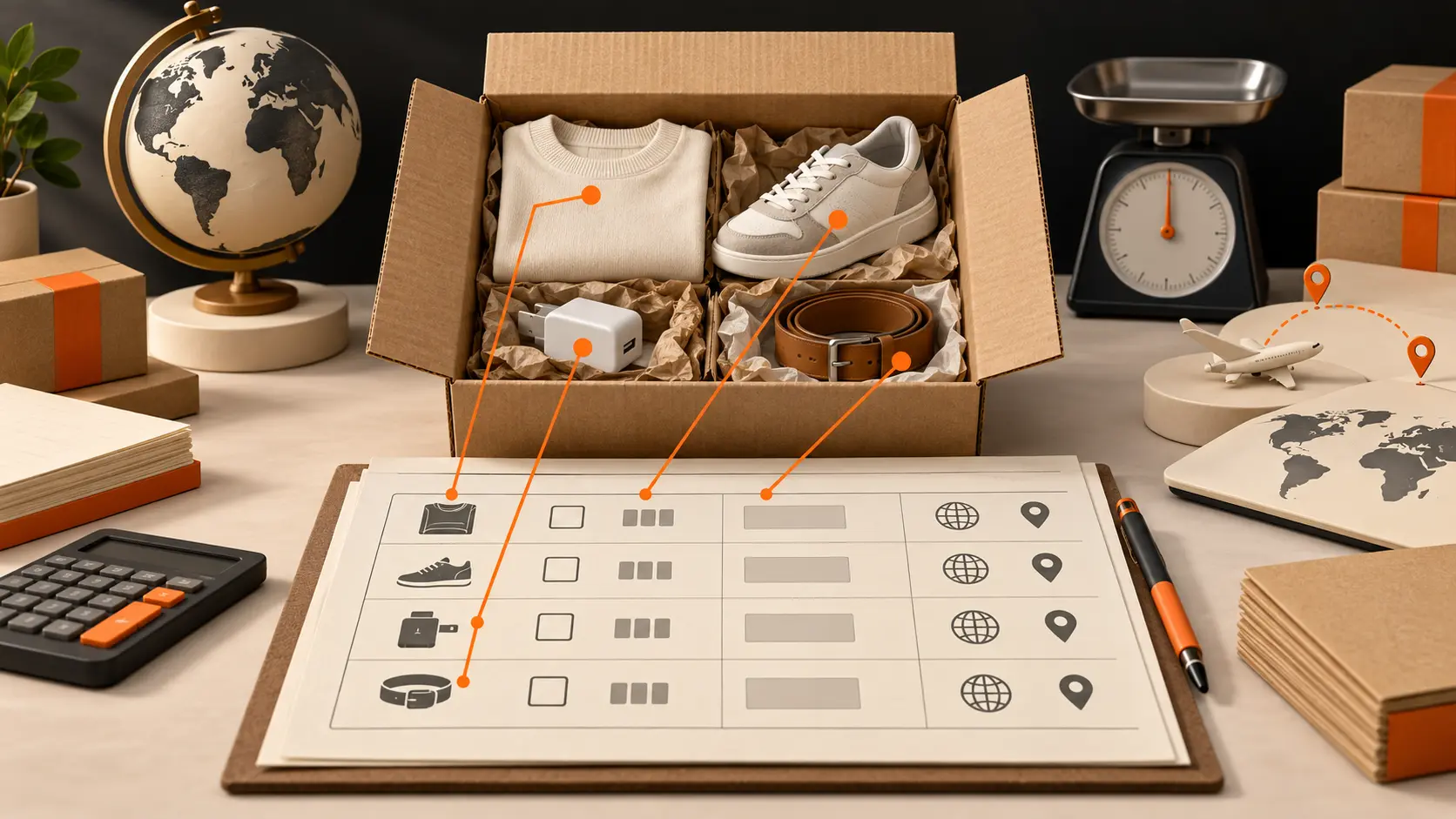
Build the declaration record before the parcel exists
A customs declaration is often treated as the last form between a packed Sugargoo parcel and international dispatch. That is too late to start thinking. A mixed haul may contain orders placed weeks apart, translated product names that no longer make sense, and several similar items with different prices. Once everything is inside one carton, reconstructing the contents from memory invites omissions and vague descriptions.
Start a declaration workbook when the first order is purchased. Give every item one row and preserve the seller-facing order name, a plain-English identity, quantity, paid value and currency. Update the row after warehouse inspection if the seller supplied a different variant or quantity. The goal is simple: the purchase record, warehouse contents, parcel selection and declaration should describe the same physical goods. Sugargoo can provide shipping options and process a parcel, but the importer remains responsible for understanding the destination’s rules and for supplying accurate information.
Use six fields that survive every handoff
A workable row needs six core fields: order reference, useful item description, quantity, unit value, currency and observable attributes that affect classification or transport. The order reference connects the declaration back to payment and warehouse evidence. Quantity prevents three shirts from appearing as one generic “clothes” line. Unit value and currency make the arithmetic reviewable rather than leaving one unexplained parcel total.
The final field captures facts such as material, intended use, battery presence or whether an item is new. Record only what you can support. “Cotton knitted pullover” is useful when the label or listing supports cotton; “premium cashmere sweater” is not useful if that claim came from a social post. Add a private note for uncertainties so you can resolve them before submitting. Do not hide a doubtful attribute by removing the item’s identity.
- One order or warehouse reference for traceability.
- A specific, ordinary-language item identity.
- Exact quantity and unit value in a named currency.
- Relevant material, use and restricted-item attributes.
Write descriptions a stranger can understand
Good descriptions are specific without becoming promotional. Use the pattern “material or type + product + use or defining feature.” Examples include cotton T-shirt, synthetic running shoes, plastic phone case and wired computer mouse. Avoid empty labels such as gift, sample, accessory, parts, merchandise or personal items. Those words say why you think the parcel is moving, not what an officer would find when opening it.
Do not copy an awkward marketplace title wholesale. Seller titles may contain search keywords, model references and claims unrelated to customs identity. Translate the product into plain English, then check it against the QC image. When a set contains physically different goods, split it into separate rows if the declaration interface permits. A belt and wallet are not made clearer by calling them a “fashion set.” Specific rows also make quantity and value reconciliation easier.
Record truthful value and keep the arithmetic visible
The safest working rule is to preserve what was actually paid for the goods and retain evidence of that transaction. Customs valuation can involve destination-specific rules, shipping charges, insurance, discounts or other adjustments, so the buyer should not invent a lower number because a forum recommends a popular amount. False or artificially low declarations can lead to questions, reassessment, penalties, seizure or loss of coverage. A so-called tax-free shipping line is also not permission to misdescribe contents.
Keep unit value separate from quantity and calculate each line total. Record the currency explicitly; a bare “20” is incomplete when the order, agent balance and destination may use different currencies. If a coupon reduced a multi-item purchase, preserve the original subtotal, discount and final payment so the allocation can be explained. If the declaration screen requests a different basis, stop and confirm the applicable guidance rather than forcing the workbook to match a guessed threshold.
Reconcile the workbook against the mixed parcel
A mixed parcel creates two common errors: a selected item disappears from the declaration, or an old workbook row remains after the item was removed. Perform a three-way match among warehouse selection, packing result and declaration rows. Count physical units, not just order numbers. One order can contain two shirts; two orders can be consolidated into one shoe pair and one accessory.
Group identical goods only when their descriptions, relevant attributes and values can be represented accurately. Do not merge a battery-powered device with a passive cable under “electronics.” The battery may affect route eligibility and transport documentation even when both products came from one seller. If rehearsal packing changes the parcel, rerun the match. The packed weight may change without altering customs value, while removing an item changes both content and declared total.
Separate route eligibility from customs treatment
Shipping-line acceptance and customs admissibility are related but different decisions. A line may accept ordinary clothing yet refuse batteries, liquids, powders or magnets. A destination may allow the product to enter but assess duty, consumption tax or handling charges. Conversely, a product restricted by the destination does not become lawful because a carrier accepts it. Sugargoo’s official route and customs guidance repeatedly directs buyers to check destination rules and line restrictions before dispatch.
Review the eligible lines shown for the exact parcel and address, not a route name remembered from an older shipment. Tax handling, weight limits, declaration requirements and service availability can change. Treat any displayed estimate as planning information, not a guarantee of clearance time or final tax. If a route uses prepaid or inclusive tax handling, read its current terms and preserve the selection screen. The declaration must remain truthful regardless of who remits the tax.
Keep a compact evidence packet beside the workbook
Your evidence packet should make every declaration row defensible without becoming a chaotic screenshot folder. Keep the order confirmation, payment record, product identity, selected variant and warehouse image for each item. Add the final parcel selection, packed-weight result and submitted declaration when available. Name the files with the order reference so a customs or support question can be answered quickly.
Evidence also reveals inconsistencies before dispatch. A receipt may show two units while the workbook says one. A QC image may reveal shoes when the translated listing title says sports equipment. A warehouse note may identify a battery that the product page obscured. Correct the source record rather than choosing whichever version seems cheaper or easier. If the available evidence cannot establish what an item is, ask for clarification or remove it from the parcel until it can be described accurately.
Run a final review like an independent checker
Before payment, put the workbook beside the parcel submission screen and review it from zero. Do not merely scan for red marks in your own notes. Confirm that every selected item has a row, every row has a selected item, quantities agree, currencies are named and line totals add correctly. Read each description while viewing the corresponding warehouse image. Ask whether a person with no marketplace context could identify the product.
Then review destination and route requirements using current official information. Check restricted categories, requested identifiers, value or tax rules, address accuracy and any carrier-specific declaration limits. Dates matter: do not rely on a threshold saved months ago. Finally, save the submitted version. A workbook that continues changing after dispatch cannot prove what information accompanied the parcel.
- Contents-to-row and row-to-contents match.
- Quantity, unit value, currency and totals reconcile.
- Descriptions identify the goods without coded language.
- Current destination and selected-line rules have been checked.
Answer customs questions with one consistent record
A customs request is not the moment to improvise a new description or total. Read exactly what document or clarification is requested, identify the affected item, and respond using the preserved workbook and evidence. If an earlier entry contains a genuine mistake, state the correction plainly and provide the supporting order or payment record. Do not send several contradictory explanations through different channels.
Track the request date, submission date, files provided and next stated checkpoint. Customs decisions and carrier handoffs can take time, and support may not control the authority’s review. A precise record helps distinguish a documentation request from routine clearance or a carrier delay. It cannot guarantee release, remove lawful taxes or cure a prohibited import, but it prevents your own information from becoming the weak link in the parcel.
Questions buyers ask about customs declarations
Who is responsible for an accurate declaration? The importer should ensure the information is truthful and should understand destination rules, even when an agent or carrier supplies the form. Can I call everything a gift? No. “Gift” does not identify the goods and should not be used to disguise a purchase.
Should I declare less to avoid tax? No. Preserve the actual transaction evidence and follow current valuation rules. What makes a useful description? A plain product name plus supported material, use or defining attribute. Can identical items share one row? Often, if their identity, attributes and unit values genuinely match and the form permits it.
Does shipping cost belong in customs value? Treatment varies by destination and service; check the current official rule rather than guessing. Does a tax-inclusive route remove declaration duties? No. Tax handling does not make inaccurate contents or values acceptable. What if Sugargoo’s translated product name is unclear? Compare the listing, order and QC image, then use understandable English supported by the evidence.
Should I use an old duty-free threshold? No. Thresholds, exemptions and special measures can change, and some destinations tax low-value imports. What should I save after submission? Keep the final declaration, parcel selection, payment evidence, route choice and any customs correspondence together.
Continue researching before you order.
View All Buyer Guides ↗