Recovery begins before the door opens
Most buyers begin documenting a problem after they discover it. By then the carton has been cut, packing material has been scattered and the relationship between a damaged corner and the item inside is difficult to reconstruct. A stronger method begins while the parcel is still in transit. Prepare a small evidence plan for every delivery whose loss or damage would matter.
Sugargoo’s official guidance directs users to the shipped area of the Packing Center to review tracking and says support can help communicate with logistics providers when a shipment appears lost, damaged or unusually delayed. Save the parcel number, tracking number, delivery address as submitted, item list and the final warehouse parcel evidence available in your account. These records describe what entered the international chain.
Create a folder named with the parcel number and delivery date. Put the records there before receipt, then charge the phone you will use to document opening. This is not an assumption that something will fail. It is a cheap way to preserve continuity between the outbound parcel and what arrives.
Record the final handoff as its own event
When delivery occurs, record the time, carrier status and person or location that received the parcel. Save the delivery notification and any visible proof-of-delivery details. If a signature or delivery receipt is provided, preserve it. Official Sugargoo material specifically recommends retaining relevant documents such as delivery receipts when a parcel issue is reported.
Do not confuse a “delivered” scan with proof that the correct parcel reached you intact. It confirms a carrier event. Compare the label with your name, destination, tracking number and parcel identity before opening. If the package is not yours, keep it closed and report the identity mismatch through the appropriate carrier and platform channels.
If the carton looks crushed, wet, punctured, re-taped or open, photograph it where it was received before moving it more than necessary. Capture the surrounding context without exposing private address information in images you do not need to share. A clear handoff record anchors later photos to a specific delivery rather than to an unidentified box on a table.
Inspect the exterior before cutting any seal
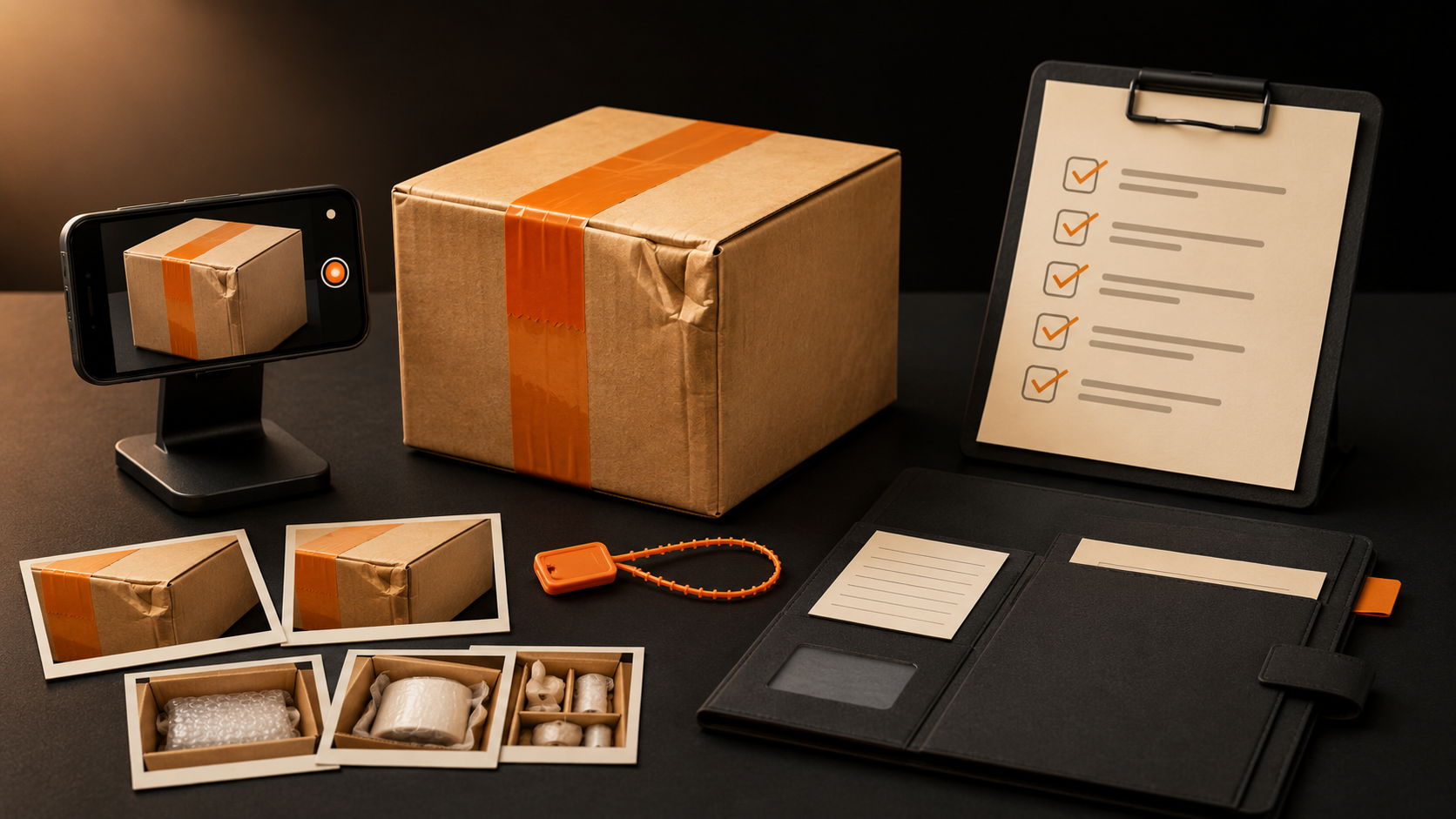
Place the unopened parcel on a clear surface with good light. Start with one wide photograph showing the entire package and shipping label together. Then photograph all six sides, each seam and every area that looks changed. Include an undamaged reference area so the viewer can distinguish ordinary handling marks from a crushed edge, tear, moisture stain or added tape.
Use two frames for a defect: one medium view that shows its location on the carton and one close view that shows detail. A close-up alone can make scale and position impossible to understand. For a puncture, show both the entry point and the panel around it. For a wet parcel, capture the spread pattern before it dries. Do not enlarge or annotate the only copy.
- Keep the shipping label readable in one private master image.
- Photograph factory tape, added tape and broken seals separately.
- Capture measurable deformation beside a ruler when useful.
- Do not discard the carton, bags, padding or label after opening.
The exterior series establishes package condition. It does not by itself prove that a damaged item was caused during transit, but it provides the first link in that explanation.
Capture one continuous opening chain
A useful unboxing record is not a performance. Position the camera so the label, sealed opening and your hands remain visible. Begin with a slow view of the unopened parcel, show the suspicious exterior areas, then open along one controlled edge. Keep the box within frame while removing layers in their original order.
Pause long enough to show padding, internal bags and the first position of each item, but do not stop recording to arrange a better scene. If an item is broken, leaking or absent, the continuous sequence makes it easier to see when that condition first became visible. Avoid cutting through product packaging or moving pieces off camera before their location is recorded.
Video supports sequence; still photographs support detail. After the first reveal, take focused photos of the internal packing, item label, damage area and any loose fragments. Keep the original video file with its metadata. Edited highlights may be convenient for explanation, but they should not replace the uninterrupted master.
Reconcile contents against the parcel, not memory
Use the parcel item list saved before delivery. Check one line at a time: order identity, product, selected variant, quantity and expected included pieces. Place every received item in a separate visible group and photograph the complete layout. Do not mark an item missing until you have checked internal pockets, nested packaging, small accessory bags and carton folds on camera.
Separate a missing product from a missing component. “Order item absent” means no unit corresponding to that parcel line was found. “Component absent” means the main product arrived but a documented included piece did not. For quantity differences, photograph all received units in one frame and preserve their individual labels where available.
Compare the received layout with warehouse QC and final parcel evidence without assuming either proves the contents by itself. Warehouse images describe an earlier checkpoint; your opening record describes delivery. The case becomes stronger when both can be matched by stable item identities rather than by vague names such as “black shirt.”
Classify the problem before requesting a remedy
Delivery problems need different evidence. A lost parcel concerns tracking, carrier confirmation and non-receipt. Exterior damage concerns packaging condition. Product damage needs exterior, internal packing and item-detail records. Partial loss needs the expected manifest, received inventory and evidence of compromised or incomplete packaging. Delay concerns the tracking sequence and the current terms of the selected route.
Do not mix several theories into one opening message. State what is directly observed and keep cause separate unless an official investigation confirms it. “The parcel arrived with a crushed right corner; the lamp inside has a broken base at the corresponding side” is observable. “The carrier threw it” is speculation.
Insurance and compensation eligibility depend on the current route, purchased protection, covered event, exclusions, evidence and reporting conditions. Do not copy a deadline or payout formula from an old post. Read the terms attached to your parcel and act within the current period shown there. This guide improves documentation; it cannot promise that a particular outcome is covered.
Build a support packet that can be verified quickly
Lead with a one-page case summary. Include the Sugargoo parcel number, tracking number, delivery date, issue category, affected item identities and the exact help requested. Then add a short event line: last normal tracking event, delivery event, first observation of the problem and when support was contacted.
Attach evidence in the same order the event happened. Start with delivery record and unopened exterior, continue through seal and internal packing, then show inventory or damage details. Give files plain labels such as exterior-front, crushed-corner, first-open, internal-padding and item-two-damage. A support agent should not have to open twenty random images to discover the sequence.
Sugargoo’s current official guidance says support can coordinate with logistics providers, initiate investigations and explore compensation where applicable. Ask for the next required step rather than declaring a guaranteed payout. If a carrier certificate, receipt or other document is requested, record the request and provide the authentic file without altering its contents.
Preserve useful originals and avoid weakening the case
Keep the parcel, internal packaging, labels, damaged products and loose pieces until the case is closed or official instructions say they are no longer needed. Do not repair, wash, discard or resell an affected item while its condition may need verification. If a leaking or hazardous item creates a safety issue, prioritize safe handling and document what you must do.
Store original media separately from working copies. Avoid filters, beauty enhancement, aggressive compression or annotations that hide context. You may make a labeled copy to point out a defect, but preserve the untouched original beside it. Back up the folder so a failed phone or expired message attachment does not erase the record.
Keep communication focused and factual. Repeated messages with changing item counts or theories make reconciliation harder. When new evidence arrives, append it to the case timeline and explain what it changes. A disciplined evidence packet does not guarantee compensation, but it gives every reviewer the same parcel identity, event order and observable facts.
Questions buyers ask about parcel evidence
Should I record every unboxing? Record parcels whose value or fragility makes a dispute consequential. A repeatable routine is easier than deciding after damage appears.
Is video alone enough? No. Video shows sequence, while still photos show labels, damage and item details clearly. Keep both when possible.
Can I open a visibly damaged box? First document all sides and seals. Then follow any current carrier or platform instruction applicable to the delivery.
What if the parcel says delivered but I cannot find it? Save the tracking and delivery details, check the recorded handoff location, then contact the appropriate carrier and Sugargoo support with specific facts.
How do I prove an item is missing? Show the expected parcel list, continuous opening sequence, internal packaging and complete received-item layout.
Should I throw away damaged packaging? No. Keep the carton, seals, padding, labels and fragments while the case may still require inspection.
Can I edit the video to make it shorter? Preserve the uninterrupted original. A shorter copy can aid explanation but should not replace the master file.
When should I contact support? As soon as you identify and document the issue, following the current reporting conditions shown for the parcel or protection.
Does good evidence guarantee compensation? No. Coverage and outcomes depend on current terms and investigation. Evidence makes the reported event easier to verify.
What belongs in the final case packet? Parcel identity, tracking and delivery record, exterior series, continuous opening record, item reconciliation, detailed damage photos, preserved receipts or certificates and one precise request. The goal is a case another person can understand without guessing what happened between delivery and discovery.