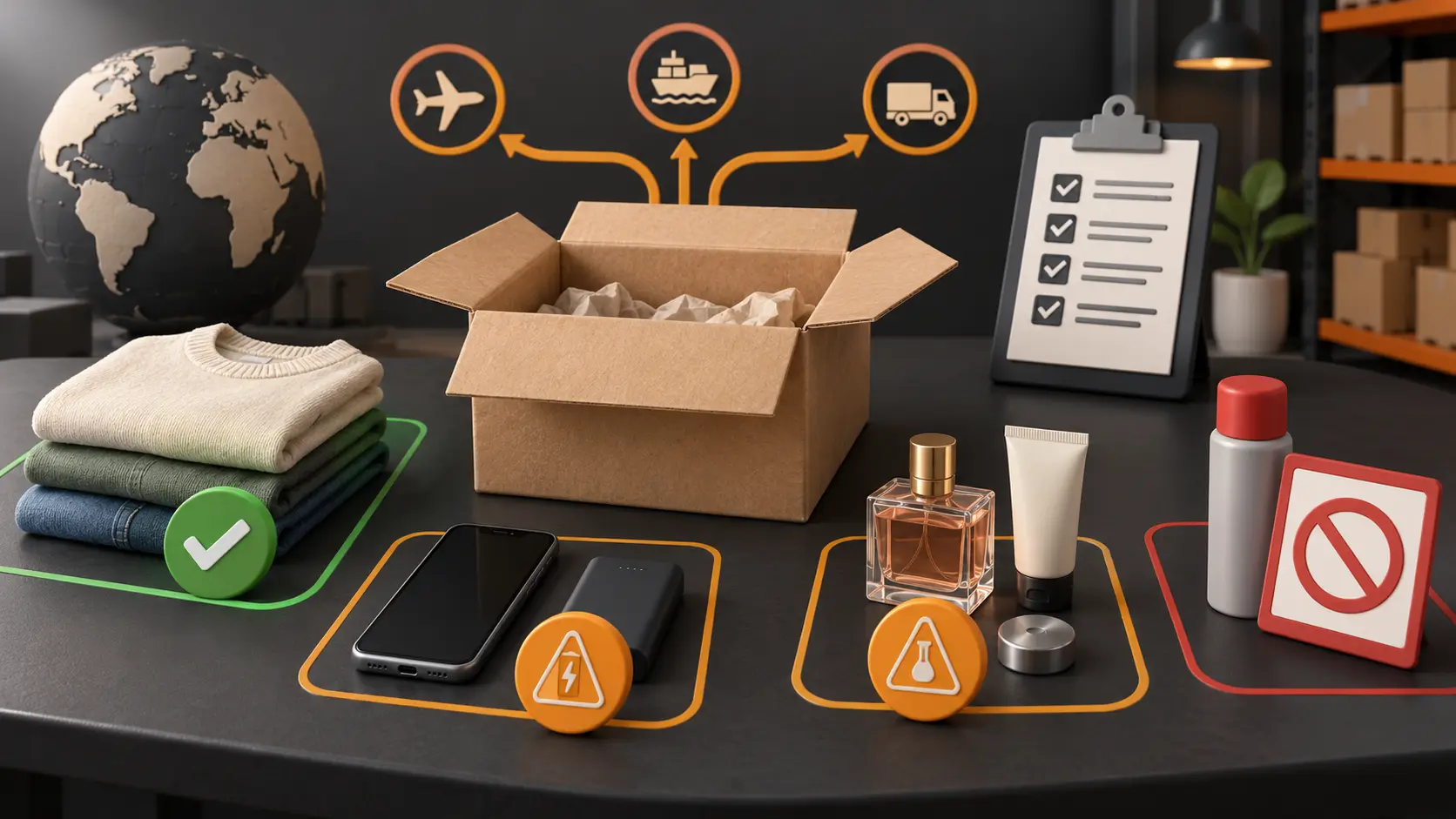
A shipping restriction begins with item identity
A parcel can look simple in the warehouse and still be complicated to move. A sweatshirt, wireless keyboard, perfume sample and souvenir magnet occupy one shelf, but they do not create one logistics profile. The difficulty appears when the international route must accept every item in the box. If one product carries a battery, liquid, powder, magnetic component or destination-specific restriction, it can narrow the available lines for the complete parcel.
Sugargoo’s official guidance distinguishes sensitive items from prohibited goods and tells buyers to check the available route and current requirements before shipment. That distinction matters. Sensitive does not automatically mean impossible; it means the item may require a compatible line, clearer product information, special handling or different limits. Prohibited goods should not be purchased for international forwarding at all. The useful habit is therefore to classify before consolidation, not after a preferred route disappears.
Use three working classes, then verify the live result
Build a three-column screen: ordinary, sensitive and prohibited. Ordinary goods are products with no obvious transport trigger, although destination law still applies. Sensitive goods are potentially acceptable but dependent on the carrier, route, packaging, quantity or destination. Official Sugargoo examples place phones, tablets and power banks containing batteries in this conditional group. Liquids, cosmetics, food, powders, magnets and other special categories can also require route-specific review rather than a blanket assumption.
The prohibited column is not a challenge to work around. Illegal drugs, weapons, ammunition, explosives and goods barred by law or carrier safety rules have no place in an international agent parcel. Do not ask for a misleading name, hidden component or false declaration to make an item appear ordinary. Classification is a safety and compliance decision, not a vocabulary trick. Because route rules change, use the three columns as a planning model and treat the current options displayed for the real parcel as the operational verdict.
- Ordinary: no identified special transport trigger.
- Sensitive: potentially shippable through a compatible route under current conditions.
- Prohibited: do not purchase or submit for international forwarding.
Build a restriction record before placing the order
A product title rarely contains everything a carrier needs to know. “Beauty tool” might be a plastic comb, a heated device with a battery or a bottle containing liquid. “Desk accessory” might contain a strong magnet. Before payment, make a compact restriction record with the exact product type, material, internal components, battery status, liquid or powder status, quantity, intended destination and seller evidence. Save the listing specification or packaging photo that supports each answer.
Record uncertainty as uncertainty. If the seller does not reveal whether a device contains a lithium cell, write “battery status unconfirmed” instead of guessing no. That flag becomes a purchase gate: ask before ordering, choose a version without the risky component or accept that route choice may be limited. This record also prevents mixed hauls from becoming anonymous. When ten warehouse items arrive across different days, the restriction trigger should already be attached to the specific order rather than rediscovered during parcel submission.
Inspect batteries as components, not just products
Battery screening fails when buyers look only for products named “battery.” The power source may be built into a phone, tablet, watch, earbud case, keyboard, light or toy. A power bank is itself stored energy, while another device may contain a removable or fixed cell. These distinctions can affect whether a carrier accepts the item and how it must travel. Use the seller specification and warehouse information to identify the component rather than assuming that a small device is harmless.
For each electronic item, record whether a cell exists, whether it is installed, whether a spare cell is included and whether the capacity or rating is visible. Never invent missing technical data. If information cannot be confirmed, ask Sugargoo support to review the actual warehouse record and current eligible lines. Also keep battery items separate in your parcel plan until eligibility is known. Combining first and asking later can make every ordinary garment inherit the restricted item’s smaller route set.
Read the contents, not the retail category
Cosmetics illustrate why category names are weak evidence. A compact mirror, pressed powder, cream, perfume and aerosol are all sold in a beauty section, yet their transport properties differ. The same is true of hobby goods: an empty display container is not equivalent to a container filled with liquid, and a decorative magnet is not equivalent to an unmagnetized metal charm. Screen the physical contents and mechanism, not the shopping category.
Use five questions. Is anything liquid, gel, cream or aerosol? Is there loose powder? Is any part magnetic? Does it contain food, plant or animal material? Is there a sharp, pressurized, flammable or chemically active component? A “yes” does not by itself prove the item can or cannot ship, but it identifies the question that must be resolved against the destination and current carrier conditions. Quantity matters too. A route that handles one consumer item may apply different limits to multiples that resemble commercial stock.
Resolve warehouse labels before building the box
When an item reaches the warehouse, review its stored name, category and any risk label beside the QC evidence. A vague listing translation can produce a description that hides the important characteristic. If a rechargeable device appears as a generic accessory, or a bottle appears as ordinary merchandise, ask for clarification before parcel creation. Correct identification helps the route filter work with the parcel you actually own.
Do not ask the warehouse to relabel a sensitive item as ordinary. Instead, provide evidence that improves accuracy: the seller specification, a photograph of the ingredients or battery mark, a model number, or confirmation that a questionable component is not included. If the warehouse assessment differs from your expectation, pause and understand why. The cost of an extra review is usually smaller than repacking after submission or discovering at handoff that the selected carrier will not accept the parcel.
Test route eligibility before comparing price or speed
Route comparison should begin with acceptance, not the cheapest estimate. Sugargoo’s international shipping guidance explains that available routes depend on destination and the goods being sent. Build a draft parcel containing only the intended items, enter the correct destination and review which lines are actually offered. Then inspect the current route details for category limits, weight and size rules, tracking, estimated timing, declaration requirements and protection terms.
A route visible for clothing alone is not evidence that it accepts the same box after perfume or a power bank is added. Test deliberately. If the platform allows parcel estimates or pre-shipment simulation, use those tools for measurement and route planning, while remembering that eligibility still depends on correct item classification. Never rely on an old screenshot, a different buyer’s destination or a carrier name alone. The same brand of service can have different acceptance rules across countries and periods.
Split a haul only when the restriction map supports it
A separate parcel can stop one sensitive item from dictating the route for everything else. Price the ordinary group on its best eligible lines, then price the sensitive item through its compatible options. Compare those two shipments with the complete mixed parcel. Include repeated base charges, packaging, insurance choices and the consequence of two tracking journeys. Splitting is useful when the recovered route choice or risk separation is worth more than the extra shipment overhead.
Do not split randomly. Keep a battery device apart from ordinary clothing if it materially restores better choices for the clothing. Separate a leak-prone cosmetic from absorbent textiles when the packing and route requirements conflict. Leave items together when they share the same eligible line and the second parcel adds cost without changing risk. The goal is not the maximum number of boxes; it is the cleanest set of compatible item groups.
Run a restriction audit before final payment
Before releasing the parcel, reconcile four records: the warehouse item list, your restriction notes, the selected shipping line and the customs declaration. Every item should appear under an accurate, understandable description. Sensitive components should match the selected route’s current acceptance conditions. Prohibited goods should never reach this stage. Confirm that quantities, destination details and any required packaging choices are consistent with what will actually be handed to the carrier.
Save the final item list, route details, package measurement, declaration and available parcel evidence. Rules can change between product research and shipment, so date the review. If a status or eligibility result changes, ask one precise question that includes the item, component, destination and chosen route. A complete record turns support from a vague “Why can’t I ship?” conversation into a checkable logistics problem.
The strongest restriction workflow is intentionally boring: identify, classify, verify, group and recheck. It does not depend on secret wording or a supposedly universal line. It produces a parcel whose contents, route and declaration tell the same story before the box moves.
Questions buyers ask about Sugargoo shipping restrictions
Does sensitive mean prohibited? No. Sensitive items may be accepted by specific routes under current conditions. Prohibited goods should not be submitted for international shipping.
Are phones and power banks treated the same as clothing? No. Sugargoo’s official guidance identifies battery-containing electronics such as phones, tablets and power banks as sensitive items that require compatible transport.
Can I remove a battery to make a device ordinary? Do not assume so. Confirm whether removal is possible, safe, permitted and reflected in the warehouse record, then check the live route result.
Is every cosmetic restricted? Cosmetics have different physical forms and contents. Identify liquids, creams, powders, aerosols and other components, then verify current destination and route acceptance.
Can the product title decide eligibility? No. Titles can be vague or translated poorly. The contents, components, quantity, warehouse classification, destination and carrier rules matter.
Should I buy the item first and solve shipping later? That can leave you with limited or no practical route. Screen the product before payment whenever a transport trigger is visible.
Will splitting always reduce shipping cost? No. It can restore route choices, but it also repeats packaging and base charges. Compare the complete plans.
Can I use another buyer’s route recommendation? Only as background. Their destination, parcel contents and timing may differ from yours.
What if the warehouse label seems wrong? Ask for a review and provide product specifications or visible evidence. Do not request a misleading label.
What is the final decision rule? Purchase only when the item is legal, accurately identified and supported by a realistic route to your destination; verify again before parcel payment.